Ice Hockey
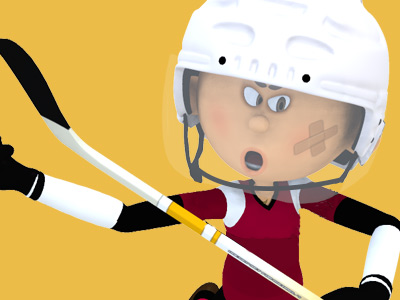
Players Equipment
In ice hockey, players use specialized equipment both to facilitate the play of the game and for protection as this is a sport where injuries are common, therefore, all players are encouraged to protect their bodies from bruises and severe fractures.
The hard surfaces of the ice and boards, pucks being shot at high speed, and other players maneuvering (and often intentionally colliding, also known as "checking") pose multiple safety hazards. Besides ice skates and sticks, hockey players are usually equipped with an array of safety gear to lessen their risk of serious injury. This usually includes a helmet, shoulder pads/chest protector, elbow pads, mouth guard, protective gloves, heavily padded shorts, a 'jock' athletic protector, shin pads and a neck guard.
Goaltenders wear masks and much bulkier, specialized equipment designed to protect them from many direct hits from the puck. The hockey skate is usually made of a thick layer of leather or nylon to protect the feet and lower legs of the player from injury. Its blade is rounded on both ends to allow for easy maneuvering. Goaltenders' skates, however, have blades that are lower to the ice and more square than round; this is an advantage to the goalies, for whom lateral mobility and stability are more important than quick turns and speed.
Hockey Helmet
A hockey helmet is worn by players of ice hockey, inline hockey, and bandy to help protect the head from potential injury when hit by the puck, sticks, skates, boards, other players, or the ice. The shell of a hockey helmet is generally made of a substance called vinyl nitrile that disperses force from the point of contact, while the liner may be made of either vinyl nitrile foam, expanded polypropylene foam, or other material to absorb the energy, to reduce the chances of concussion. Hockey helmets grip the head from inside by cupping the back of head, or the occipital protuberance. Helmet manufacturers will have a chart that relates their helmet sizes to head measurements. On older models, the helmet size is adjusted by loosening the screws on the side to slide the front portion forward or back.
Visors and Shields
A visor or face shield in ice hockey is a device attached to the front of a helmet to reduce potential of injury to the face. Visors cover the upper half of the face, while full face shields cover the entire face. A series of eye injuries, most notably that to Greg Neeld (the first player to wear a visor in professional hockey) and Bryan Berard have led to a call from many to enforce their wearing. As of 2017, 94% of NHL players wear visors. Many other leagues around the world mandate the use of visors. Visors and shields, made of a high impact-resistant plastic, offer better overall vision than the wire cages available, which can obscure vision in certain areas. The face shield provides excellent straight ahead and peripheral vision, but does not provide as good air flow as a cage.
The American Hockey League, the top minor league in North America required all players to wear a visor prior to the start of the 2006–07 season. The NHL "strongly recommends" the use of visors. In 2013, the NHL began requiring all players with fewer than 25 games of experience to wear visors.
The hockey visor was first invented by Kenneth William Clay when he lost vision in his left eye to a high stick while playing for the Vanderhoof Bears. After a month in hospital in Vancouver, Clay created the first documented clear face shield in January 1964. The invention caused quite a stir, with announcers calling it a "fish bowl" and a "wrap-around windshield". While the original shield and helmet were lost in the fire that consumed the Vanderhoof Arena a few years later, the newspaper clippings still attest to the dates and facts.
Full Facial Protection
A cage in ice hockey is a device attached to the front of a helmet to reduce potential of injury to the face. It consists of a metal or composite mesh that covers the entire face, although some half cages do exist (to protect the eyes while allowing full airflow). The bars, or cage, are spaced far enough apart to allow seeing through to the action but are close enough to stop pucks and sticks from getting through to injure the face. A hybrid variation of the full-face shield, which uses a polycarbonate face shield on the top half and either a polycarbonate or metal cage on its bottom half is also available.
Full facial protection is mandatory in many amateur leagues and in North America, full face cages, full shields, or shield and cage combination are mandatory in high school hockey, college hockey, and for all players under the age of 18.
In 2002, the British Journal of Sports Medicine published a study identifying the protection offered against concussions between the half-face shield and the full-face shield. The use of a full-face shield compared with half-face shield significantly reduced the playing time lost because of concussion, suggesting that concussion severity may be reduced by the use of a full-face shield.
Neck Guard
For "skaters", a neck guard typically consists of a series of nylon or ABS plates for puncture resistance, with padding for comfort and fit and a tear-resistant nylon mesh outer covering. For goalies, the neck protector is usually a curved panel of clear Lexan and hangs just underneath the mask from nylon cords, somewhat in the manner of a metal military gorget. Both are intended to reduce the potential for injury to the neck or throat by a puck or skate blade.
Shoulder Pads
Hockey shoulder pads are typically composed of a padded vest with front and back panels, with velcro straps for closure, and soft or hard-shelled shoulder caps with optional attached upper arm pads. These pads primarily protect the chest, ribs, solar plexus, spine and shoulders against flying pucks and collisions with other players or the ice. They are not required by all recreational leagues ("no-check" leagues penalize offensive checking, and lower-skill leagues rarely see pucks leave the ice) and are often omitted for practice sessions not involving body contact, but they are virtually always worn by players during games.
Elbow Pads
Provides forearm and sometimes triceps protection against pucks in addition to a reinforced elbow cup. Elbow pads are vital for all hockey players. The pads can protect the elbow joint and arm bones from bruises and prevent fractures. The elbow pads cover the elbow joint and part of the upper and lower arms. Some elbow pads do have extensions that can cover the entire upper arm. The majority of elbow pads are adjustable and are secured with Velcro straps.
Hockey Jersey
Covers the shoulder and elbow pads. Jerseys are color-coded and numbered for team and player identification, and teams, especially at upper skill levels, may have multiple jersey styles for home and away games. Traditional hockey jerseys are oversized, roughly square, and made using fabrics with limited elasticity. A "fight strap" is required to be used in most professional leagues; this connects the jersey to the inside of the pants and prevents an opponent in a fight pulling the player's jersey over their head. Newer jerseys are more form-fitting due to the use of elastic fabrics, and resemble NFL jerseys in their overall fit.
Hockey Glove
There are two styles of gloves worn by ice hockey players. Skaters wear similar gloves on each hand, while goaltenders wear gloves of different types on each hand.
Skaters' Gloves
Skaters gloves help prevent the hands getting bruised and battered and stops them from getting burned from the ice. The top padding and shell thumb is designed to help protect the player from flying hockey pucks and opponents' ice hockey sticks.
In today's hockey game, gloves will generally fall into two types of categories, the first being the traditional four-roll style. These types of gloves have more room on the inside, giving it a looser feel on the hand than the natural fit gloves. Hockey players who choose the four-roll style have less resistance in their fingers and hands, so wearing the gloves feels less noticeable. The other category of gloves are the tighter fitting, natural or anatomical fit glove. These have a much tighter fit than the four-roll gloves, and are designed to become an extension of the players' hand. The tapered gloves are tight on the hand, but ergonomically designed for better wrist mobility and range of motion. Hockey gloves also range in sizes, and are generally available in three categories: Youth size hockey gloves run 8 inches (20 cm), 9 in (23 cm) and 10 in (25 cm); Junior sizes are 11 in (28 cm) and 12 in (30 cm); and Senior sizes run 13 in (33 cm), 14 in (36 cm) and 15 in (38 cm).
Goaltender's Gloves
Goaltenders wear a different type of glove on each hand. While these gloves do offer the goaltender a measure of protection, their design is to aid the goaltender in performance of their duties. On the hand with which they carry their stick, often called the "stick hand", the goaltender wears a blocker with a large pad across the back of the forearm, usually extending just beyond the wrist. National Hockey League rules mandate that the blocking glove may be no wider than 8 in (20 cm) and no longer than 15 in (38 cm). The goaltender uses this blocker to deflect shots.
On the other hand, often called the "glove hand", the goaltender wears a catching glove called a trapper, which is similar to a baseball glove. In addition to using it to catch shots, goaltenders can distribute caught pucks by tossing them from the catching glove. National Hockey League rules limit the perimeter of the catching glove to 45 in (110 cm) and the widest part of the glove may not exceed 18 in (46 cm). Most goaltender's glove hands are their non-dominant hand like in baseball, but exceptions do exist.
Hockey Pants
These are knee-length oversized shorts, which incorporate the thigh, pelvic, hip and tailbone pads, and cinch at the waist. They are often held up by a belt or suspenders.
Jockstrap or Ladies' Pelvic Protector
The jock is a protective cup which is designed to protect the genitals. The cup easily fits into a strap or some type of sports support. Some jock straps come with inbuilt garter belts so that one can wear long socks at the same time. Many companies now make "jock shorts" which are a jockstrap incorporated into a pair of boxer or athletic shorts, or into elastic shorts similar to "boxer briefs", which increases coverage of the garment and helps position the cup more securely against the player's anatomy without shifting. Similar garments, called "pelvic protectors" or informally "jillstraps", provide a hard shell protecting the female genitalia and the lower pelvis from impact.
Garter
Garter belts are often used by players to hold up hockey socks. A garter is simply an elastic band that goes around the waist and has several straps that go down to the front and back of the legs. At the end of each strap is a clip or a hook which attaches to the sock. The latest garters belts come with Velcro straps which makes it easier to attach the socks. Many hockey pants and jock shorts now have built-in garters in the form of a velcro patch on the front and rear of the leg, which grab and hold the sock.
Shin Guards
Incorporating a kneepad as well, the shin guard has a hard plastic shell on the front and outside to protect against pucks, but usually has little or no protection on the calf. Shin guards help protect the knee joint and the frontal bones of the leg from pucks, sticks, skates, falls and other impacts. However, it is essential to buy proper shin guards. If the shin guard is too long it will slip down into the skate and prevent proper movement of the ankle; if the shin guard does not fit perfectly at the knee joint, then the patella will not be properly protected and lead to injury. There is a size scale for shin guards which most sports stores have available and which one can utilize to assess the right size.
Hockey Socks
Hockey socks are ankle-to-thigh garments worn over protective gear by ice hockey players. They are form-fitting, and traditionally made of a cotton or synthetic rib-knit fabric.
Experiments have been made with a lightweight fabric sock, of material similar to that used in hockey jerseys, and most recently (mid-2000s) with a streamlined lightweight sock used by the U.S. Olympic and other international teams. Hockey socks should not be confused with hockey skate socks which are thin, traditional-style socks worn over the foot (inside the skate).
Hockey socks are held up either by a garter (old style) or attached to undershorts with Velcro tabs. Players usually keep their socks inside the upper ankle area of their skates.
Athletic tape is generally used below the knee to hold the sock in place, and sometimes at the ankle as well. Hockey socks, along with a jersey, are considered part of a team uniform under USA Hockey's rule 304(a) (2005–06 season) and are required as coverage for protective equipment (shinguards). Organized teams wear hockey socks in designated team colors, complementary to the team jersey.
Mouthguard
Many variants exists from standard plastic guards to custom-moldable "boil and bite" compounds that make speaking easier. In the days past, many hockey players had the front teeth missing and this was because of the failure to protect the teeth from knock downs and fights. Today, most hockey players wear mouth guards to protect their teeth and jaw. The mouth piece can also soften blows to the face and prevent jaw fractures.
Ice Skates
Hockey skates incorporate a rigid shell, form-fit to the player's foot using memory foam and/or heat-moldable components, often reinforced with metal mesh to prevent a skate blade cutting through. Unlike figure skates, hockey skate blades have a rounded heel and no toe picks as these can be dangerous in a "pile-up". Ice skates are essential for all hockey players. One should always try on a pair of hockey skates before buying them. Hockey skates come in many styles and sizes. The essential component of all skate is the interior boot, exterior holder and the attachable blade. Most skates have rigid toe caps and heel/Achilles ridge protectors. Typically the tongue of the skate should end at or just above the beginning of the shin guard.
Hockey Puck
A hockey puck is either an open or closed disk used in a variety of sports and games. There are designs made for use on an ice surface, such as in ice hockey, and others for the different variants of floor hockey which includes the wheeled skate variant of inline hockey (a.k.a. roller hockey). They are all designed to serve the same function a ball does in ball games.
A closed disk hockey puck having the shape of a short cylinder made of vulcanized rubber is used in the sport of ice hockey. Hockey pucks are designed for use on either an ice surface, dry floor, or underwater, though open disk designs have only been used on floors.
Ice hockey requires a hard disk of vulcanized rubber. A standard ice hockey puck is black, 1 inch (25 mm) thick, 3 inches (76 mm) in diameter, and weighs between 5.5 and 6 ounces (156 and 170 g); some pucks are heavier or lighter than standard. Pucks are often marked with silkscreened team or league logos on one or both faces. Pucks are frozen before the game to reduce bouncing during play.
Hockey Stick
Made of wood or composite materials, hockey sticks come in various styles and lengths. Stick dimensions vary based on the size of the player. Traditionally, all sticks were wooden up until the late 1990s; wood is inexpensive and tough, but the characteristics of each stick will be subtly different due to small changes in the grain structure. They also allow less flex before breaking. The most advanced ice hockey sticks are made from graphite and are manufactured with precise flex patterns that allow for more accuracy and power when hitting the puck; however these advantages come with a flip side of increased cost and somewhat lower overall durability. Graphite sticks come in one-piece and two-piece varieties; a two-piece stick (composed of shaft and blade) allows for greater customization with reduced parts stock required of retailers, and allows for a damaged shaft or blade to be replaced without replacing the entire stick. One-piece sticks generally have better flex characteristics towards the bottom of the shaft, but if the stick breaks or becomes unusable, it is discarded entirely.
SPORTS

RESOURCES
This article uses material from the Wikipedia articles "Ice Hockey", "Ice Hockey Equipment", "Hockey Helmet", "Glove Ice Hockey", "Hockey Sock", which is released under the Creative Commons Attribution-Share-Alike License 3.0.
© Stories Preschool. All Rights Reserved.