Queen Anne's War (1702–1713)
Queen Anne's War (1702–1713) was the second in a series of French and Indian Wars fought in North America involving the colonial empires of Great Britain, France, and Spain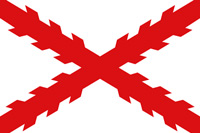 The Spanish Empire was a colonial empire governed by Spain and its predecessor states between 1492 and 1976. One of the largest empires in history, it was the first to usher the European Age of Discovery and achieve a global scale, controlling vast territory. It was one of the most powerful empires of the early modern period, reaching its maximum extent in the 18th century.; it took place during the reign of Anne, Queen of Great Britain. In Europe, it is generally viewed as the American theater of the War of the Spanish Succession; in the Americas, it is more commonly viewed as a standalone conflict. It is also known as the Third Indian War. In France
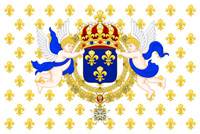 The Kingdom of France is the historiographical name or umbrella term given to various political entities of France in the medieval and early modern period. It was one of the most powerful states in Europe since the High Middle Ages. It was also an early colonial power, with possessions around the world. Colonial conflicts with Great Britain led to the loss of much of its North American holdings by 1763. The Kingdom of France adopted a written constitution in 1791, but the Kingdom was abolished a year later and replaced with the First French Republic. it was known as the Second Intercolonial War.
The war broke out in 1701 and was primarily a conflict among French, Spanish and English colonists for control of the North American continent while the War of the Spanish Succession was being fought in Europe. Each side was allied with various Indigenous communities. It was fought on four fronts:
- In the south, Spanish Florida and the English Province of Carolina attacked one another, and English colonists engaged French colonists based at Fort Louis de la Louisiane (near present-day Mobile, Alabama), with Indigenous bands allied on each side. The southern war did not result in significant territorial changes, but it resulted in seriously decimating the Indigenous population of Spanish Florida and parts of southern Georgia, with destruction of the network of Spanish missions in Florida.
- In New England, English colonists and Indigenous allies fought against French colonists and their Indigenous forces, especially in Acadia and unsettled border frontier with Canada. Quebec City was repeatedly targeted by British colonial expeditions, and the British captured in 1710 the Acadian capital Port Royal. French colonists and the Wabanaki Confederacy sought to thwart British expansion into Acadia, whose border New France
 New France was the territory colonized by France in North America, beginning with the exploration of the Gulf of Saint Lawrence by Jacques Cartier in 1534 and ending with the cession of New France to Great Britain and Spain in 1763 under the Treaty of Paris. In the 16th century, the lands were used primarily to draw from the wealth of natural resources such as furs through trade with the various indigenous peoples. In the seventeenth century, successful settlements began in Acadia and in Quebec. defined as the Kennebec River in what is now southern Maine. They executed raids in the Province of Massachusetts Bay (including Maine), most famously the Raid on Deerfield in 1704 and one on Groton in 1707, in both cases taking numerous captives to Montreal and Kahnawake (a Mohawk mission village) for ransom or adoption by Mohawk families.
 - In Newfoundland, English colonists based at St. John's disputed control of the island with the French colonists of Plaisance. Most of the conflict consisted of economically destructive raids on settlements. The French colonists successfully captured St. John's in 1709, but the British colonists quickly reoccupied it after the French abandoned it.
- French privateers based in Acadia and Placentia captured many ships from New England's fishing and shipping industries. Privateers took 102 prizes into Placentia, second only to Martinique in France's American colonies. The naval conflict ended with the British capture of Acadia (Nova Scotia).
The Treaty of Utrecht ended the war in 1713, following a preliminary peace in 1712. France ceded the territories of Hudson Bay, Acadia, and Newfoundland to Great Britain The Kingdom of Great Britain was a sovereign country in Western Europe from 1 May 1707 to the end of 31 December 1800. The state was created by the 1706 Treaty of Union and ratified by the Acts of Union 1707, which united the kingdoms of England (which included Wales) and Scotland to form a single kingdom encompassing the whole island of Great Britain and its outlying islands, with the exception of the Isle of Man and the Channel Islands. while retaining Cape Breton Island and other islands in the Gulf of St. Lawrence. Some terms were ambiguous in the treaty, and the concerns of various Indigenous communities were not included, thereby setting the stage for future conflicts.
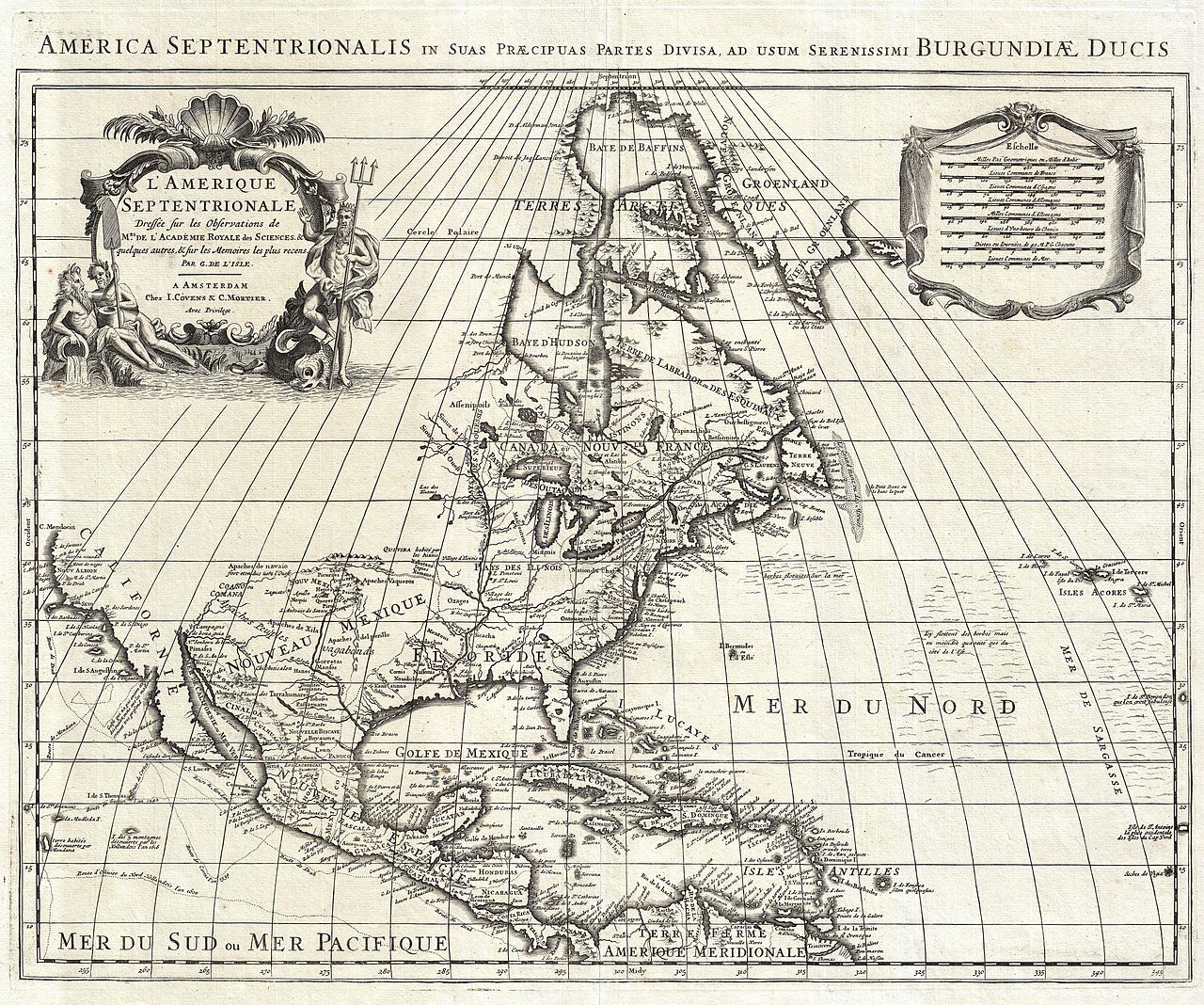
1700 map by Guillaume De L'Isle of North America, reissued by Covens and Mortier in 1708
1700 map by Guillaume De L'Isle of North America, reissued by Covens and Mortier in 1708
( Click image to enlarge)
HISTORY



RESOURCES
This article uses material from the Wikipedia article "Queen Anne's War", which is released under the Creative Commons Attribution-Share-Alike License 3.0.
© Stories Preschool. All Rights Reserved.